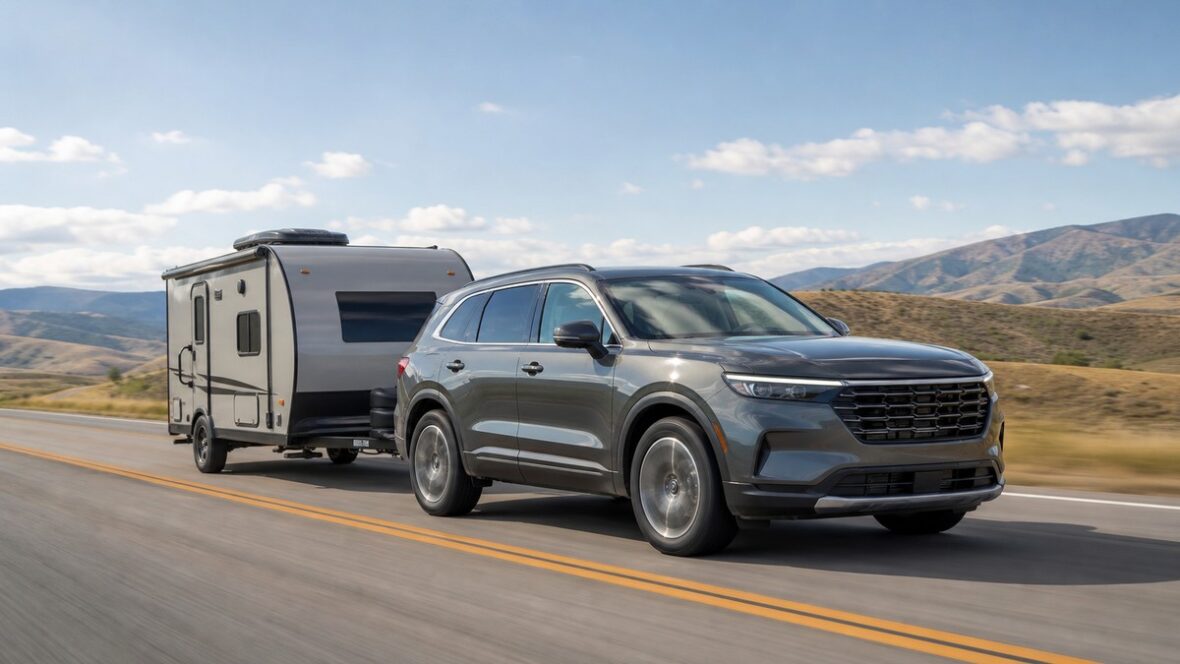
That big tow-rating number on the window sticker looks reassuring, but it only tells part of the story. A hybrid SUV can hit another limit before it reaches its advertised towing figure, and ignoring them is how a smooth trip turns into a white-knuckle one. A little math up front keeps you honest.
- Payload or tongue weight can become the limiting number before the advertised tow rating.
- Tongue weight usually lands around 10 to 15 percent of the loaded trailer weight.
- Weight, speed, and terrain all cut range, and electrified powertrains feel it too.
Why One Number Never Tells the Whole Story
Marketing loves a single, tidy figure. Real towing works with a stack of limits, and every one of them can stop you first. The tow rating is the ceiling for what the vehicle can pull. Payload is a separate ceiling for what the SUV carries beyond its curb weight, including passengers, cargo, added equipment, and the downward force the trailer puts on the hitch. Depending on the vehicle and load, that limit can arrive before the advertised tow rating.
This is the part shoppers miss. The trailer’s listed weight is a starting point, not a finish line. A camper’s dry or listed weight leaves out water in the tank, propane, food, bikes, and the pile of stuff you toss in the night before you leave. All of that adds up, and all of it counts against your limits. Weigh the real load, not the brochure number.
Tongue Weight Is the Quiet Deal-Breaker
Tongue weight is the portion of the trailer’s weight that presses down on the hitch, and it typically works out to somewhere between 10 and 15 percent of the loaded trailer weight. Pull a 5,000-pound trailer and you might be putting 500 to 750 pounds straight onto the back of the SUV. That number lives inside your payload budget, so it eats into what you have left for people and cargo.
Get it wrong in either direction and handling suffers. Too little tongue weight and the trailer can start to sway. Too much and you overload the rear axle and lighten the front. This is exactly why a vehicle rated to tow a certain weight on paper can feel completely wrong once you actually load it. The tow number was fine. The tongue weight and payload were not.
Range, Cooling, and the Hybrid Reality
Adding weight and speed to any vehicle costs you efficiency. The U.S. Department of Energy and EPA are blunt about it on FuelEconomy.gov, where they note that hauling heavy loads, carrying extra weight, and driving faster all measurably lower fuel economy. A trailer is a rolling wall of wind resistance, and that drag climbs sharply the faster you go.
Electrified powertrains show this even more plainly. Add a trailer and the gas engine and its cooling have to work harder for longer stretches, and that sustained effort has real limits. On the fully electric side, road testing has repeatedly shown that towing can cut usable range dramatically, sometimes slicing it roughly in half or worse. A hybrid SUV won’t strand you the way a drained battery might, since the gas engine keeps working, but your fuel stops will come faster and your effective range will shrink once a loaded trailer is behind you.
Heat matters too. Long climbs and highway speeds ask a lot of the engine, transmission, and battery cooling systems. That’s why route and pace belong in your planning right alongside weight. Flat interstate at a steady speed is one thing. Steep grades in summer heat are another, and they shrink your margins fast.
Put the Math Ahead of the Trip
Before you commit to a trailer, add up the honest weight of everything, check it against both the tow rating and the payload, and confirm the tongue weight fits your budget. Then plan a route and a cruising speed that respect the cooling and range hit you’ll actually see. Do that homework once, and every trip after it feels calm instead of nervous. The numbers aren’t there to scare you. They’re there to keep the whole rig pointed the right way.